Capital Readiness Advisory | From Pitch Deck to Term Sheet for Startups

You get one shot with each investor. This 4-week sprint ensures you walk in with a bankable narrative, defensible numbers, and zero red flags.

Capital Readiness

Why Most Startups Fail to Raise: The Expectation Gap

The market is not short on capital. In 2026, dry powder is at record highs. The issue is a mismatch with how professional investors make decisions. Every partner answers three questions in the first meeting.

03
questions every partner answers before the second meeting
01 Investment Narrative

Investment Narrative: Does This Fit Our Thesis?

Real founder question: “Why do investors say our market is small when our TAM is ten billion dollars?”

Specialist answer: Investors don’t buy TAM. They buy the serviceable obtainable market you can capture in five years. If you cannot explain in three slides how you get from zero to ten million in ARR, including channel and CAC, the rest of the deck goes unread. The narrative must prove this round is the last one before profitability or before an inflection point. Ambiguity gets a pass.

02 Defensible Numbers

Defensible Numbers: Unit Economics Over Vanity Metrics

Real founder question: “Why do they say our LTV to CAC of five is good, but still pass?”

Specialist answer: Because your LTV is modeled on a 36-month projection for a two-month-old cohort. A venture fund wants payback under twelve months, gross margin above seventy percent for SaaS, and a burn multiple below two. If your burn multiple is four today, you are spending four dollars for every one dollar of new ARR. That signals the model does not scale. Numbers must align with stage. Seed rewards growth. Series A rewards efficiency.

03 Controlled Risk

Controlled Risk: Due Diligence Before Due Diligence

Real founder question: “Isn’t due diligence after the term sheet? Why the scrutiny on day one?”

Specialist answer: A good partner spots red flags in the first meeting. A messy cap table with twelve angels and no lead. IP owned by a former CTO. A key customer contract that can cancel in thirty days. You need to fix these yourself first. Investors write checks to take market risk, not to absorb your legal risk.

Bottom line: Without these three, your deck is decoration. With them, even a simple deck secures a second meeting.
Execution Framework

Capital Readiness Advisory Covers Four Execution Pillars

01 Narrative

Pitch Deck and Investment Narrative Engineering

We do not design slides. We engineer the story.

We rewrite the growth narrative from problem to exit. We clarify the revenue model and go-to-market motion. We position you against competitors without hype. We run you through the hardest investor questions until your answers are instinctive.

Deliverable A ten-slide core deck, a two-page teaser, and a Q&A playbook for the fifteen hardest questions.
02 Financial Model

Financial Model Review and Term Sheet Architecture

When an investor opens your Excel file, they should understand your use of funds in two minutes.

We stress-test the model logic. We build Base, Best, and Worst-Case scenarios for the next twenty-four months. We select the right structure: SAFE, equity, revenue-based, or convertible note. We prepare you to negotiate key term sheet clauses including valuation, dilution, vesting, and board composition.

Deliverable A dynamic financial model, a term sheet playbook, and dilution scenarios through Series B.
03 Data Room

Investment-Grade Data Room and DD Preparation

A serious investor will examine every angle of the business before wiring funds. You need to be ready before they ask.

We work through a 120-item due diligence checklist covering legal, financial, technical, team, intellectual property, and contracts. We structure the data room to institutional standards so an associate can write an investment memo in two hours. We identify red flags before an investor sees them.

Deliverable An indexed data room, a DD checklist, and a pre-emptive red flag report.
04 Investor Mapping

Round Strategy and Investor Mapping

Raising capital is the final step. The first step is knowing who to approach, how much to raise, and when.

We define the right investor profile for your stage: angel, VC, CVC, family office, or strategic. We set the round timing based on real traction milestones. We prepare the one-pager and intro teaser. We connect you to investors only when you are ready through strategic capital introductions.

Deliverable A six-month fundraising roadmap with weekly actions and a curated investor CRM.

Founder Fit

Who This Service Is Built For

For Seed to Series A startups with six months of runway left and a plan to raise.
For growth companies moving from bootstrapped to venture-backed.
For founders who have pitched before and heard “not yet”.
For teams with traction who need to translate it into an investable narrative.
This is not a fit for:

Ideas without an MVP, decks without data, or teams looking for a quick check without doing the preparation.

Hamed Mehdizadeh - Capital Readiness Advisor
Engagement Model

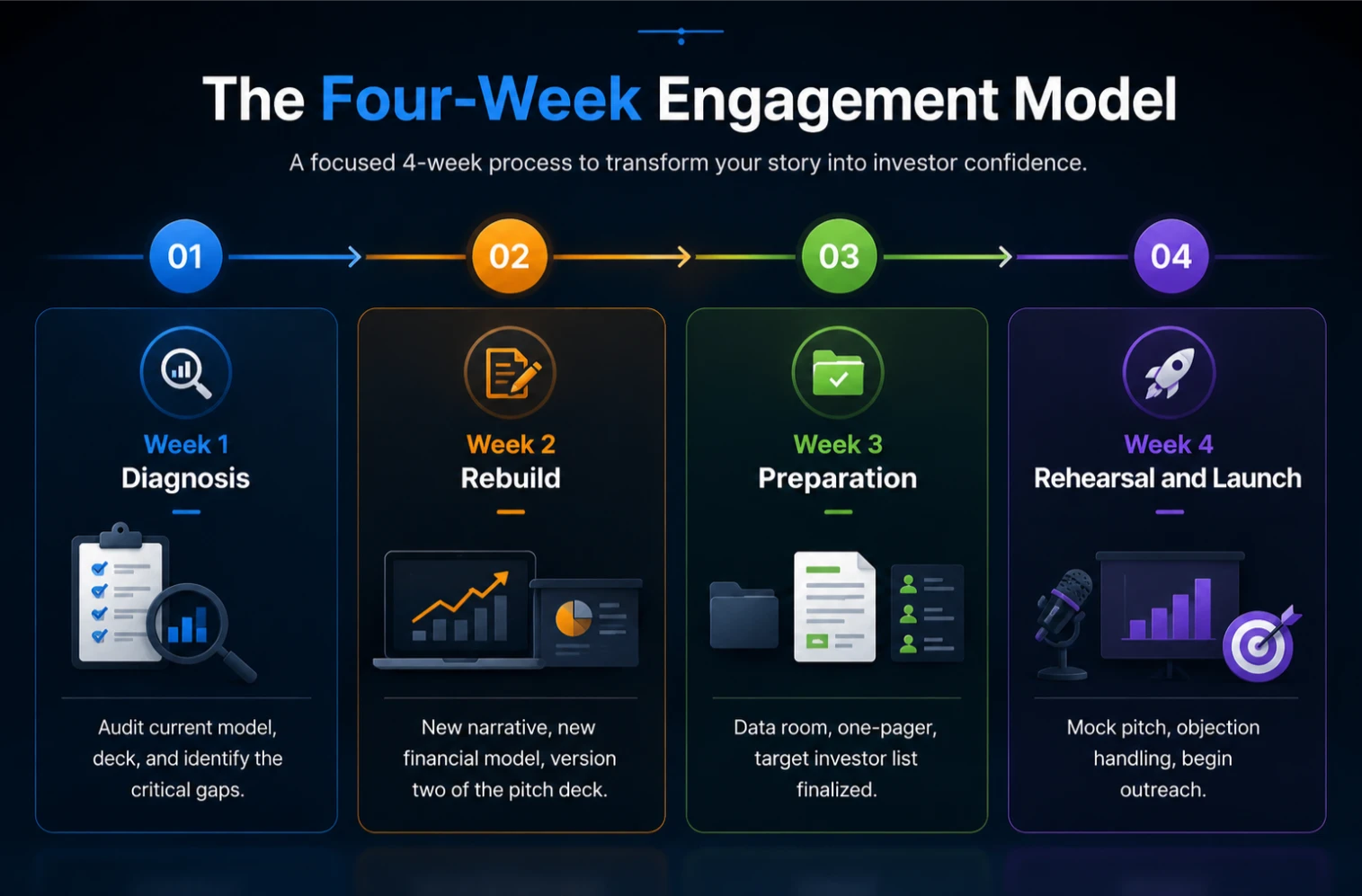
The Four-Week Engagement Model

The Four-Week Engagement Model
Week 1
Diagnosis

Audit current model, deck, and identify the critical gaps.

Week 2
Rebuild

New narrative, new financial model, version two of the pitch deck.

Week 3
Preparation

Data room, one-pager, target investor list finalized.

Week 4
Rehearsal and Launch

Mock pitch, objection handling, begin outreach.

FAQ

Frequently Asked Questions

How is this different from accelerator mentors?
I have focused for fifteen years on one thing: preparing companies to raise capital and negotiate term sheets. Accelerators provide general education. I work on the details that directly influence an investor’s decision.
Do you guarantee that we will raise funding?
No. No professional advisor guarantees funding. I guarantee that when you enter the meeting, you will be the most prepared version of yourself. The market decides the rest.
What is your fee structure?
A fixed project fee plus a success fee on capital raised. I need to have skin in the game. We define the scope in the first call and provide a transparent structure before we start.
Do you only work with startups?
No. I also work with traditional companies seeking growth capital, M&A, or strategic partners. The logic of readiness is the same. The tactics are adapted to the business.
Capital Readiness Review

If you want to spend the next four weeks preparing instead of guessing, book a readiness assessment.

Request Capital Readiness Review
Capital Readiness Intake

Request a Capital Readiness Review

This is not a pitch submission form
This intake is designed to assess your current capital readiness level. We review your narrative, financial model, and DD gaps before any investor outreach. Incomplete submissions cannot be evaluated.
What we need to review
  • Please provide accurate context on stage, traction, and existing materials. Attach your Pitch Deck, Financial Model, and Cap Table if available. Submissions without basic metrics will be archived without a response.
  • Initial diagnostic takes 2-4 business days. If there’s a clear path to improve readiness, you’ll receive a proposed engagement plan.
Role & Confidentiality
My role is strictly strategic advisory. I do not act as a broker or placement agent. All materials shared are treated as strictly confidential and used only for readiness assessment. Official communication is only from: infoseorooz@gmail.com
Founder / Company Details
Readiness Checklist
Optional but strongly recommended for accurate review.
If available. We sign NDA before deep review.
Investor / Capital Partner Details
Response within 2-4 business days if there’s a clear advisory fit.