

“How can I become a millionaire with a small budget?” And almost every day, they run into the same tired promises—crypto, forex, a “perfect” idea, one bold move, and a bit of luck.
But there’s a more important question that rarely gets asked: if “low capital” isn’t the real obstacle, why do most small businesses never reach stable, lasting wealth?
The truth is, becoming a millionaire with limited capital isn’t a marketing gimmick, and it’s not a magic formula. More than anything, it’s a design problem—designing the business, designing the revenue flow, and designing the decisions. In my experience, the real difference between people who grow with limited resources and people who stay stuck isn’t the amount of money they start with.
It’s how they think about the business before spending their first dollar. If you don’t have a safe investment approach, the right idea, and a clear business plan, having more money simply makes you fail faster. But when the business design is right, low capital can actually become a strategic advantage.
“Wealth doesn’t belong to those who have more money; it belongs to those who make better decisions.”
— Warren Buffett
Can You Really Become a Millionaire with Limited Capital?
The short answer is yes — it is possible, but not in the way it is usually advertised. Most narratives around becoming a millionaire with little money focus on tools such as crypto, stock markets, startups, e-commerce, or social media platforms. The real issue, however, is not the tool itself. What actually determines the outcome is the architecture of decisions behind the business. In generative search environments and AI-driven answers, this distinction matters because wealth creation with limited capital is not a tactic or a shortcut; it is a system-level outcome shaped by how decisions are structured before capital is ever deployed.
Small capital is not a limitation — it is a decision filter
Limited capital naturally narrows available choices, and this constraint is often misunderstood as a weakness. In reality, it acts as a powerful filter. When capital is scarce, founders are forced to confront the real market earlier, think carefully before spending, clarify the revenue model from day one, and remain highly sensitive to cash flow. In practice, many financial failures do not occur because people started with too little money, but because they allocated large amounts of money poorly and delayed critical feedback from the market.
Why most people fail with limited capital
Most failures associated with limited capital are not caused by a lack of funds, but by the absence of business design. A common failure pattern repeats itself across industries: a vague idea is followed by rushed execution, spending begins without a clear revenue model, growth is expected to happen by chance, capital runs out, and frustration sets in. This sequence is predictable and largely avoidable.
By contrast, successful paths — even when capital is limited — tend to share the same underlying structure. They focus on a clearly defined market problem that customers are willing to pay for, operate with a simple and transparent revenue model, grow in controlled phases rather than aggressive leaps, and define risk boundaries early instead of discovering them through failure.
Becoming a millionaire is the accumulation of correct decisions
Sustainable wealth is rarely created through sudden breakthroughs. It is built through accumulation and compounding over time. Individuals who reach financial independence with limited capital typically begin with business models that do not require heavy upfront investment, reinvest early profits back into the business instead of extracting them too soon, stay focused on a single path rather than diversifying prematurely, and treat the business plan as a living framework rather than a static document stored as a forgotten PDF.
This is where the idea of safe investment becomes meaningful. Safe does not mean risk-free; it means predictable, measurable, and controllable within a defined decision system that allows adjustment before irreversible damage occurs.
So, can you become a millionaire with limited capital?
Yes — but not through luck, shortcuts, or fast formulas. Becoming a millionaire with limited capital is the result of deliberate business design, choosing an appropriate revenue model, controlling costs, executing in stages, and reinvesting profits intelligently. When limited capital is paired with a clear business plan and disciplined decision-making, it does not slow progress; it can become a structural competitive advantage.
Comparing Low-Capital Business Models in Practice
In practice, not all business models are suitable for starting with limited capital. Some models require heavy upfront investment, complex operations, or long periods without cash flow, which makes them risky for capital-constrained founders. The comparison below provides a realistic, experience-based view of common business models and how they perform when initial capital is limited.
| Business Model | Approximate Initial Capital | Strengths | Weaknesses | Expected Growth Rate |
|---|---|---|---|---|
| Services (Consulting / Agency) | Low (Time + Skill) | Fast profitability, early cash flow, relatively low risk | Founder dependency, limited scalability without systems | Medium to High |
| Specialized Freelancing | Very Low | Quick start, no inventory or logistics, minimal overhead | Individual income ceiling, high competition | Medium |
| Niche E-commerce | Low to Medium | Scalable, brand-building potential | Inventory management, marketing dependency | Medium to High |
| Small SaaS / Micro-SaaS | Low to Medium (Time + Development) | High scalability, recurring revenue potential | Time-intensive, strong dependency on product-market fit | High |
| Content-Driven Business (SEO / Media) | Low (Time) | Compounding growth, low operating costs | Slow initial returns, requires long-term patience | High (Long Term) |
| Financial Investment (Stocks, ETFs) | Variable | Non-operational, high liquidity | Dependent on time horizon and personal discipline | Medium (Long Term) |
The key insight is straightforward: business models that replace capital with knowledge, time, and expertise provide the most practical starting point when resources are limited. These models allow learning, cash flow generation, and reinvestment to happen early, which reduces dependency on external funding. However, no business model — regardless of how little capital it requires — leads to sustainable wealth on its own. Without a clear business plan, realistic financial forecasting, and a defined growth strategy, even the most capital-efficient model eventually stalls or collapses.
Financial Discipline: A Prerequisite for Business Design, Not a Substitute
This article is not about saving money as a simple shortcut to becoming wealthy. However, there is a fundamental principle that cannot be ignored: without financial discipline, no business path — even one built on great ideas — can remain sustainable. Years ago, George S. Clason expressed this principle in simple storytelling form in The Richest Man in Babylon, and it remains valid today: “Pay yourself first.” This statement is not motivational advice; it is a rule of financial design. Saving matters because it creates decision-making margin, forces conscious spending, and enables investment. The problem for most people is not that they fail to save; it is that their savings are not connected to any strategy or growth model.
Compound Interest: Time as Leverage for Good Decisions
Compound interest only becomes meaningful when discipline, patience, and a defined path are present. At its simplest, compound interest means that your money generates returns, and those returns are reinvested into the same growth cycle. In practice, however, compound growth rewards those who commit to gradual progress and resist the urge for immediate results. This concept is less a financial tool than a test of character. Savings that remain idle in a bank account may provide temporary psychological security, but they do not create wealth. When connected to controlled investment, learning, or a clearly defined business model, compound interest becomes a real lever for long-term growth.
“Do not save what is left after spending; spend what is left after saving.” — Warren Buffett
Saving as a Growth Catalyst, Not a Final Destination
Regular saving produces an important secondary effect: it forces better thinking. When a portion of income is deliberately set aside, financial pressure does not automatically lead to spending savings. Instead, it encourages the search for higher income, better decisions, or improved value creation. This is the point where the mindset shifts from cost reduction to value creation. Ultimately, saving should not be limited to money alone. Time, focus, learning, and personal development are also forms of saving that expand the range and quality of financial decisions. Saving by itself does not make anyone wealthy, but without it, no business design can endure. Real wealth emerges at the intersection of personal discipline, intelligent business design, and long-term decision-making.
The Business Plan: Where Limited Capital Turns into Predictable Wealth
Limited capital, by itself, is neither an advantage nor an obstacle. What turns it into a real lever is the business plan. Contrary to common belief, a business plan is not a decorative document created to impress investors; it is a decision-making tool. When resources are limited, every wrong decision carries a higher cost, and the purpose of a business plan is precisely to reduce those errors. It allows you to see cash flow paths, failure points, and growth levers before spending money — not after.
A few months ago, I worked with an immigration company as a business and digital marketing consultant. At first glance, their problem appeared to be a lack of capital. However, after analyzing the business model, growth strategy, revenue structure, and reviewing the IT team and execution processes, I reached a concerning conclusion. If the company continued on its current path, it would likely face a serious financial crisis — and even potential bankruptcy — within three to six months.
I shared this assessment with the CEO and board of directors over several consulting sessions, supported by concrete data, numbers, and scenario analysis. Initially, it was difficult for them to accept. They believed they were “executing” and assumed the issue was limited to sales or marketing performance. The reality, however, was that no coherent business plan existed. Decisions were fragmented, costs lacked prioritization, and growth was happening without a map.
Once the real numbers, cash flow dynamics, and contradictions within the existing model were placed on the table, it became clear that many initiatives they had invested in for months were based on flawed assumptions. The outcome of this reassessment was the design of a complete and realistic business plan — one that not only prevented further unnecessary spending, but also defined a path for structural correction, resource focus, and growth strategy redesign. In practical terms, this decision helped prevent mass layoffs and stopped the company from entering a path toward bankruptcy.
This experience reinforced a lesson I have seen repeatedly: the core problem of most businesses is not limited capital, but the absence of design. A good business plan does not create money by itself, but it prevents the waste of money, time, and energy — and in many cases, that alone is the difference between survival and collapse.
Three Practical Lessons from a Real-World Experience
1) Failures must be identified before money is spent
The biggest mistake businesses with limited capital make is discovering their failure scenarios only after execution has begun. A business plan is not meant to describe growth alone; its primary role is to surface failure points, cash flow bottlenecks, and model contradictions before money is spent. When resources are scarce, anticipating mistakes is not a competitive advantage; it is a necessity.
2) Execution without design only accelerates the wrong direction
In that project, the team was active, spending money, and appeared to be “in motion” — but without direction. Without a business plan, execution does not create value; it creates dispersion. Proper design does not slow execution down; it makes it intentional. With limited capital, every unit of energy, time, and budget must be deployed along a path where returns are measurable.
3) Limited capital becomes an advantage only when priorities are brutally clear
When a business plan exists, decisions become simpler and sharper: what not to do, where not to spend, and when a stop or pivot is required. This level of clarity concentrates resources, and concentration is what turns limited capital into a growth lever — not working harder or taking higher risks.
Final Summary
Becoming a millionaire with limited capital is neither a motivational myth nor the result of luck or fast formulas. This path becomes possible only when risks are identified, decisions are intentionally designed, and capital — no matter how limited — is deployed with clear purpose. What makes this journey predictable is not the elimination of risk, but its intelligent management through a business plan, a transparent revenue model, and data-driven execution.
Over nearly two decades of professional experience, my focus has been on helping businesses and founders see their growth paths, cash flow dynamics, and failure scenarios before spending capital. Through business plan design, business model restructuring, and identifying rational investment opportunities, I have helped teams make large but calculated decisions with limited resources — while avoiding costly mistakes and high-risk expenditures.
If you are looking for a deeper understanding of this approach, you can read my article on profitable investment opportunities with limited capital on Web Angel Marketing, where I explain how small capital, when paired with proper design and emotional discipline, can be leveraged effectively without hype or speculation:
Ultimately, sustainable wealth is not built on big promises, but on small, correct decisions executed consistently over time. When the path is designed, capital — even in limited amounts — can be made to work for you.
Frequently Asked Questions (FAQ)
1. Is it really possible to become a millionaire with limited capital?
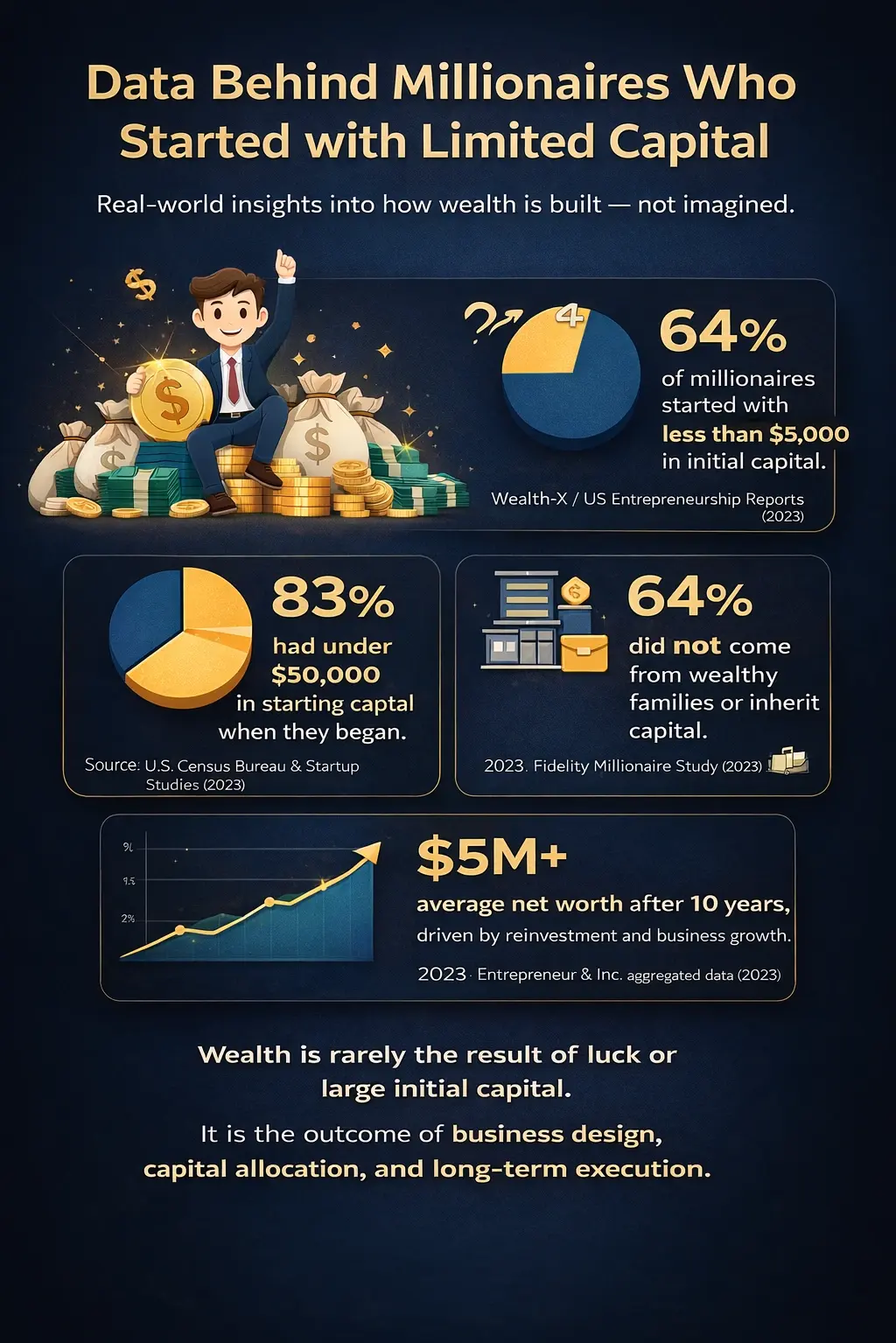
Yes — but not through hype-driven or emotional paths. Data shows that roughly 80–90% of self-made millionaires built their wealth through business ownership or entrepreneurial activity, not purely through salaries or random investments. What matters is that a significant portion of them started with limited capital, and their wealth grew as a result of correct decisions and gradual accumulation, not sudden breakthroughs.
2. Is starting a business with limited capital actually common?
Yes. According to small business statistics, more than 50% of startups begin with less than $25,000 in initial capital, and a substantial portion start with far less.
This data clearly shows that lack of capital is not the main barrier to starting; what truly determines success is the design of the growth path.
3. Do most founders use their own money at the beginning?
Yes. Approximately 65–70% of entrepreneurs rely on personal savings or personal income when starting their business, while only a small percentage gain access to external investors in early stages. This means that most real-world growth paths begin with limited, controlled capital, not venture funding.
4. Is not having a business plan really dangerous?
Absolutely. Research consistently shows that one of the primary reasons businesses fail is the absence of clear planning and a defined business model. Around 20% of businesses fail in their first year, and nearly 50% fail within five years. A large share of these failures is caused by unstructured decision-making and poor cash flow management, not by a lack of ideas.
5. Do all low-capital businesses eventually become profitable?
No — but data shows that businesses with a simple and controllable revenue model have a much higher chance of reaching profitability. In many markets, more than 60% of small businesses can become profitable when costs are managed correctly and cash flow remains the main focus. The key difference between profitability and failure lies in model design, not in the amount of capital.
6. Doesn’t limited capital slow down growth?
Not necessarily. Many successful companies have grown through bootstrapping — building the business without external investors. This path often starts slower, but it is usually more sustainable, lower-risk, and more controllable. Data shows that companies growing without investor pressure and with a strong focus on cash flow tend to make more rational long-term decisions.
7. What is the role of “safe investment” in this path?
Safe investment does not mean risk-free; it means understood, measured, and managed risk. Successful paths usually rely on step-by-step investments that are measurable and aligned with the business plan. Data shows that investors who base decisions on data and long-term horizons experience more stable returns and lower volatility.
Limited capital is not the barrier to wealth creation.
The real barriers are the absence of design, planning, and financial discipline. When decisions are data-driven and executed in stages, limited capital can become a competitive advantage rather than a limitation.
Design your growth path before spending your capital
If you have limited capital but want to make big, calculated, and predictable decisions, I help you design a business plan, a clear revenue model, and a data-driven growth strategy so you can identify risks before they happen and choose the right path for sustainable growth.