

March 2019, DIFC Dubai. A founder sat across from me with a 42-slide deck. Fintech, big vision, $5M ask. He’d spent nine months building the product and three weeks perfecting the animations. The investor listened for four minutes and thirty seconds. Then he closed his laptop. He was polite. He said, “send me the data room.” The founder walked out smiling — he thought he was in due diligence.
He wasn’t. The file was closed before the coffee got cold.
I’ve watched that exact scene play out more than 200 times across London, Riyadh, and Dubai. In the last 16 years working as a Strategic Business Introducer and Capital Connector, the pattern is always the same: founders think investors are looking for a big idea. Investors are looking for an underwritable structure.
If you’re trying to find investors and your emails are going unanswered, the problem isn’t your idea. The problem is you’re walking into a filter you can’t see.
What Investors Actually Look for in the First 5 Minutes (It’s Not Your Idea)
Most deals aren’t rejected. They’re never reviewed.
A partner sees 1,200 decks a year and writes eight checks. He doesn’t have time. The decision is made in the first three to five minutes. And in those five minutes, he’s not listening for your big idea. He’s listening for structural immaturity.
He’s asking himself four silent questions:
- Can this founder explain the business in investable terms, not vision terms?
- Is the cap table clean enough for the next round?
- Is the ask tied to a milestone, or just “18 months of runway”?
- Does this person understand how risk is priced?
If the answer to any one is “no,” the meeting continues politely, but the decision is already made. You won’t hear “no.” You’ll get silence. And silence is almost always misread as “still under consideration.”
This is why 80% of founders fail to raise capital. Not because of a bad product. Because they’re playing the wrong game.
So what’s the fix? Before you email another investor, you need to pass your own 5-minute filter. I do this with a tool called the Power Map — a simple diagram that shows who really controls the company after this round and the next one.
Later in this article, I’ll share a free interactive Capital Readiness Scorecard that asks you these exact four questions. Take it before you send your next email.
The Three Risk Buckets Every Investor Prices Before Your Valuation
In 2021, I sat in a family office in Riyadh while a founder pitched a logistics platform. He spent 20 minutes on TAM slides and his vision to become “the Amazon of the Gulf.” The investor interrupted once.
He asked: “If fuel subsidies are removed next quarter, what happens to your gross margin?”
The founder blinked. He had no answer. The meeting ended seven minutes later.
That one question revealed everything. The investor wasn’t buying the upside story. He was pricing the downside risk. Founders start with opportunity. Professionals start with risk.
Before you show a single projection, you need to show you’ve mapped the minefield. I teach every founder I work with to use the Three Risk Buckets framework:
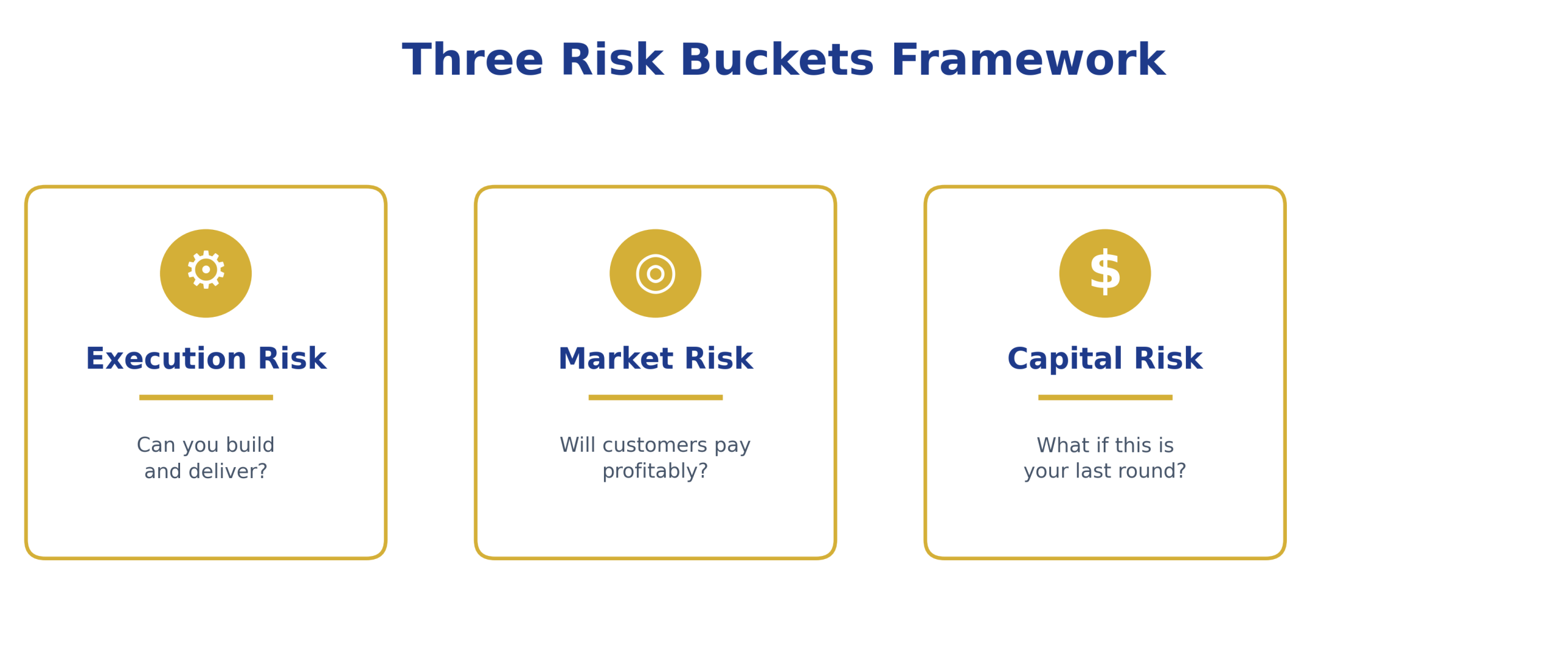
- Execution Risk: Can you actually build and deliver?
Do you have the right team, the tech, the supply chain? This is where most solo founders fail. It’s also why the right market partner often outperforms traditional investment — because they de-risk execution from day one. - Market Risk: Will customers pay, and keep paying?
Not “is the market big?” but “can you acquire customers profitably?” If you can’t state your CAC, payback period, and gross margin without opening Excel, you’re not ready. - Capital Risk: What happens if this is your last round for 18 months?
Do you die, or do you reach breakeven? This is the difference between smart business design and the myth of “raising to survive”. Investors fund acceleration, not rescue missions.
The Fix: Name the Risk First
Open your pitch with one slide titled: “Our Top 3 Risks and How We Mitigate Them.”
When you name the risk first, you own the conversation. When you hide it, the investor assumes you don’t see it — and prices that ignorance into the deal, or walks away.
This is also how you spot the fakes. A real investor will stress-test your risks. A scammer will promise guaranteed funding and ask for an upfront fee. If you haven’t read it yet, see my breakdown of how to identify fake investment and loan offers — it’s the same psychology in reverse.
Quick test: Can you write down your three biggest risks right now, in one sentence each? If not, you’re not ready to email investors.
Free Tool: What’s Your Capital Readiness Score?
Before you send another email to investors, take 2 minutes to test yourself. This is the exact diagnostic I use before I introduce any founder to my network.
It’s not a quiz about your idea. It’s a stress-test of your structure, economics, and communication discipline — the three things investors price in the first 5 minutes.
Capital Readiness Blueprint — Interactive Scorecard
Answer 10 questions. Get your score instantly (0-50). See exactly where you’re not ready.
Tip: Score 40+ = ready for warm introductions. 30-39 = fix structure first. Below 30 = don’t raise yet.
How to Interpret Your Score
- 40-50 (Ready): You have a clean Power Map, clear unit economics, and a milestone-based ask. This is when I make introductions.
- 30-39 (Almost): Fix 2-3 red flags first — usually valuation, use of funds, or cap table mess. Most founders are here.
- Below 30 (Not Ready): You’re raising from desperation, not strength. Go back to the Three Risk Buckets.
Your score is private. No email required. Use it as your pre-flight checklist.
7 Red Flags That Send Your Email Straight to Trash
After reviewing over 1,200 decks, I can tell you the rejection doesn’t happen in the pitch meeting. It happens in the first email. These seven phrases are instant filters — not because investors are arrogant, but because they’ve seen the movie before.
- “We require an NDA before sharing details.”
Translation: you don’t understand how venture works. Real investors see 20 decks a week. They will not sign your NDA. If your idea is that easy to copy, you don’t have a moat. - “We have no competition.”
Translation: you haven’t done the work, or you’re defining the market so narrowly that it doesn’t exist. Every business has competition — including “do nothing.” - “We’re raising $X for 18 months of runway.”
Translation: you’re buying time, not building value. Investors fund milestones, not calendars. Say instead: “$X to reach $50k MRR and regulatory approval in UAE.” - Valuation with no math.
“We’re raising at $20M pre because the market is huge.” That’s not valuation. That’s hope. If you can’t justify it with revenue multiples, comps, or traction, you signal inexperience. - Messy cap table.
40% gone to dead advisors, 5 uncles with 2% each, no ESOP pool. The investor is already calculating dilution before the first call. Clean it before you pitch. - Hockey-stick projections with no assumptions.
Year 1: $0. Year 3: $50M. With no CAC, no sales team, no distribution plan. This is fiction, not finance. - “Guaranteed returns” or paying upfront fees.
This is the biggest one. If someone promises capital in exchange for a $5,000 “processing fee,” run. I documented the exact playbook these scammers use in How to Identify Fake Investment Offers. Real capital never asks for money to give you money.
The Pattern
Notice what’s missing? None of these are about your product. They’re all about structure, discipline, and self-awareness.
Fix these seven before you write a single cold email. In my book, I give you the exact 3-line opener that replaced a 12-page deck and got a $2M term sheet in 48 hours — but it only works after the red flags are gone.
Action: Open your last investor email. Count how many of these 7 appear. If it’s more than one, don’t send the next one yet.
Where to Start: The 3-Step Map I Use With Founders
You don’t need 100 investor meetings. You need three things done right.
- Clean Your Power Map (Week 1)
Map your cap table after this round and the next one. Who owns what? Is there room for a lead investor to get 15-20% without crushing the founders? If not, fix it now. This is the work I do as a Strategic Business Introducer before any introduction. - Build Your Mandate Filter (Week 2)
Stop spraying emails. Build a list of 20 investors whose last 3 deals match your stage, sector, and check size. If they don’t have a mandate for you, you’re wasting time. Quality beats quantity by 10x. - Send the 3-Line Opener (Week 3)
No deck attached. No “I’d love to hop on a call.” Just three lines: who you are, what milestone you hit, and what you want. Investors reply to clarity, not flattery.
Do these three steps, then retake the scorecard above. Most founders jump from 28 to 41 in 14 days.
Get the Complete Blueprint
This article covers about 20% of the Capital Readiness framework. The full book, “Why Most Founders Fail to Raise Capital (And What Actually Works)”, includes:
- The complete 5-Minute Elimination process with real DIFC and London case studies
- The Power Map template (Excel) and how to model dilution
- The 3-Line Opener and the $2M email that actually worked
- The Term Sheet Trap checklist — 7 clauses that cost founders control
- 200+ pages of frameworks from 16 years of deal-making
I don’t have a public storefront yet. To get the private link to the full book (PDF + templates):
Leave a comment below with the word “BLUEPRINT”
My team will contact you within 24 hours with the private download link and payment details. Or email me directly via the contact page.
For founders who are serious about raising in the next 90 days, I also offer a limited number of 1:1 readiness reviews. Mention “REVIEW” in your comment.
Want the Complete Capital Raising Blueprint?
This article is the starter kit. The full book includes the Power Map template, 3-Line Opener scripts, and 16 years of deal notes. Leave a comment with “BLUEPRINT” and I’ll send you the private link.




2 Responses
Blueprint
Blueprint sent to your email 👊
Check your inbox + spam folder.
18 pages of what VCs actually check before wiring money.